What is DSIP? The original peptide
The chemical identity is unusually tidy. The biological origin is much harder to account for.
Sequence and identification
DSIP stands for delta sleep-inducing peptide. It is a nonapeptide, a chain of nine amino acids, with the sequence Trp-Ala-Gly-Gly-Asp-Ala-Ser-Gly-Glu. The name and sequence come from the original rabbit characterization by Schoenenberger and Monnier in 1977.
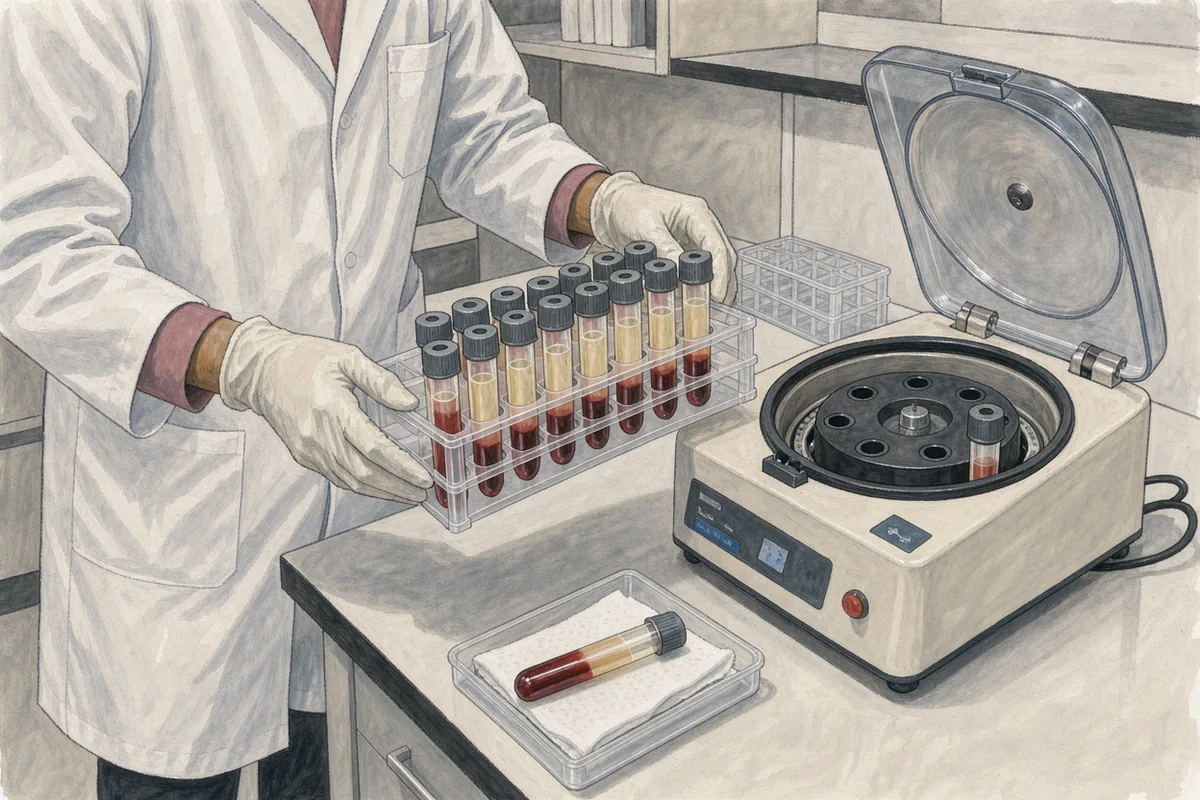
The experiment began with cerebral venous blood from rabbits in electrically induced sleep. The isolated peptide enhanced delta and spindle EEG activity when infused into the brain. This was an animal experiment with a very particular route of administration.
The mismatch between precise chemistry and unsettled function surprised me. The substance has an identity. The gene, precursor and specific receptor remain unconfirmed.
Plasma, milk and cerebrospinal fluid
Endogenous means originating within the body. DSIP has been reported in mammalian plasma, milk and cerebrospinal fluid, frequently bound to a carrier protein. Its proposed functions have ranged well beyond sleep, into stress and neuroendocrine research.
The carrier protein helps describe what researchers encounter in a sample. The still-unidentified precursor would explain where the peptide comes from. Those are separate entries in the account of its biology. My curiosity points upstream, toward the precursor.
Natural occurrence alone cannot establish the safety of administering a substance. The small human studies leave long-term exposure and interactions unresolved.
Emideltide and phospho DSIP
Emideltide is DSIP's International Nonproprietary Name, the formal name assigned to the substance as a candidate drug. No emideltide product has been approved by any regulator. The historical literature records a range of proposed roles and continuing physiological uncertainty.
Phospho DSIP, also called DSIP-P, is a phosphorylated form: it carries an attached phosphate group. The distinction matters when a result is attributed broadly to DSIP. The 2006 review found the clearest sleep-promoting effects among structural analogues, a group of altered molecules. A finding about that group cannot settle the clinical effect of the original chain.
The DSIP research page separates the original peptide, phospho DSIP and the engineered fusion peptide used in a newer mouse experiment.
DSIP military claims and spelling searches
For a search such as “d cip” or “d sip,” the molecule discussed here is DSIP, delta sleep-inducing peptide. “Original DSIP” refers here to the original sequence described above.
I have no military study to cite from this record. The documented starting point is the rabbit characterization; a claim about military development or military use would need a source of its own. Neither the peptide's sleep-related name nor its formal drug name establishes such a history.